The IRCTC Journey Behind India's National Rail Tourism Brand
Some projects arrive through official notifications. Others are born through years of institutional learning, collective experience and the vision of countless people who quietly build capabilities over time.
The story of Bharat Gaurav belongs to the second category.
Although Bharat Gaurav emerged as a distinct initiative in 2021, its foundations had been laid much earlier. Around 2004–05, the Ministry of Railways introduced the concept of Village on Wheels, which later evolved into Bharat Darshan. The objective was to make organised tourism accessible to ordinary Indians by offering affordable rail-based tour packages. IRCTC was entrusted with operating these special trains and, over the years, its tourism team painstakingly developed the expertise required to transform the concept into one of India's most successful organised rail tourism products.
Through carefully curated itineraries, efficient operations and an unwavering commitment to passenger satisfaction, IRCTC created a strong foundation in religious and cultural tourism. Nearly one hundred Bharat Darshan circuits were being operated annually, covering destinations across the country. The organisation had learnt how to design itineraries, manage large tourist movements, coordinate with multiple agencies, provide end-to-end travel experiences and, above all, earn the trust of passengers..
My own association with IRCTC began in 2006. During my initial years, my responsibilities were largely connected with Information Technology and systems that supported the tourism business. While I was not directly leading tourism operations, working closely with the tourism team gave me an opportunity to understand the complexity of organised rail tourism, the operational challenges involved and the immense passion with which the teams created memorable travel experiences. As GGM north zone led team north zone that operated many such trains on popular religious circuits.
When I assumed charge as Director (Tourism & Marketing) in 2018, I inherited not merely a business vertical but a rich institutional legacy. My responsibility was not to create that legacy but to build upon it. Together with an experienced and committed tourism team, we continued to expand the portfolio of religious and cultural tourism products. Several pilgrimage circuits gained tremendous popularity, particularly the Shri Ramayana Yatra, which received an overwhelming response from passengers and demonstrated the growing demand for professionally managed religious tourism.
Competing in the travel industry has never bee never easy.Private Online Travel Agencies such as MakeMyTrip, Cleartrip and Yatra were investing heavily in technology, marketing and customer acquisition. Yet IRCTC continued to strengthen its position because it possessed something that could not be created overnight—years of operational experience, a deep understanding of rail tourism, strong institutional relationships, proven execution capability and, above all, a team that believed in the product it was creating.
When the Ministry of Railways introduced the Bharat Gaurav Policy in 2021, encouraging public and private operators to lease trains and develop theme-based tourism circuits, many organisations saw an attractive business opportunity. IRCTC certainly recognised the commercial potential, but it also saw something much larger.The organisation saw an opportunity to transform years of experience into a National Tourism Brand.
Unlike Bharat Darshan, the Bharat Gaurav policy offered operators the flexibility to create their own products and determine package pricing while operating within the framework prescribed by Indian Railways. After several rounds of discussions with stakeholders, the policy was further refined to make it commercially viable and operationally attractive. The organisation was not starting from the beginning. It was building on nearly two decades of accumulated knowledge, operational excellence and passenger confidence.
The Bharat Gaurav rakes could be leased by anyone. What could not be leased was the experience that IRCTC had painstakingly built over almost two decades
That institutional strength enabled IRCTC to respond with confidence, move faster than most others and emerge as the leading operator under the Bharat Gaurav scheme. While a few private operators also entered the sector, IRCTC's long experience in rail tourism, its dedicated teams, established systems and unwavering commitment to passenger service gave it a distinct advantage. This institutional readiness also explains why, after the COVID-19 pandemic, IRCTC was among the first organisations to revive organised tourism successfully and scale up Bharat Gaurav operations across the country.
It was against this backdrop that the proposal to create IRCTC's own fleet of Bharat Gaurav trains was placed before the Board of Directors. What followed was not merely the approval of ten rakes. It was the beginning of a journey that would transform ordinary railway coaches into one of India's most recognisable tourism brands.
That, I believe, will make this chronicle credible, dignified and worthy of becoming part of IRCTC's institutional history.
“Our objective was never to decorate a train. We wanted every rake to become a moving ambassador of India. Every coach would celebrate a different dimension of the country—its monuments, festivals, cuisine, architecture, wildlife, yoga, dance traditions and spiritual heritage. Together they would become a kaleidoscope of Bharat travelling across the railway network, inspiring passengers long before they reached their destinations
The Board's approval marked the beginning of an entirely new journey for IRCTC. Looking back, I often feel that what was approved that day was not merely the procurement of ten train rakes. It was the beginning of creating a national tourism brand that would eventually become one of the most visible symbols of rail-based tourism in India.
The decision to indent for ten Bharat Gaurav rakes was neither impulsive nor based on optimism alone. It was backed by years of institutional learning. IRCTC had already demonstrated its capabilities through Bharat Darshan, luxury tourism products and several successful pilgrimage circuits. The organisation understood the pulse of domestic tourism and had the confidence of passengers. More importantly, it possessed a team that knew how to convert ideas into successful tourism products.
The post-COVID period further strengthened our confidence. While many sectors were still recovering, domestic tourism witnessed an extraordinary revival. Religious tourism, in particular, was growing rapidly as families and senior citizens once again began travelling across the country. IRCTC was among the first organisations to revive organised tourism after the pandemic because it already possessed an established network, experienced professionals and proven operational systems. This institutional strength enabled it to move much faster than most private operators who were entering the Bharat Gaurav scheme for the first time.
The Bharat Gaurav rakes could be leased by anyone.
What could not be leased was nearly two decades of experience that IRCTC had painstakingly built in rail tourism.
That experience became the organisation's greatest competitive advantage.
The mission before us was therefore much larger than manufacturing trains. Our objective was to create a tourism product that would inspire confidence among passengers, generate sustainable commercial value for the organisation and, at the same time, become a moving ambassador of India's culture, heritage and spirituality.
The project demanded a completely different way of thinking. These trains could not resemble ordinary passenger trains because they were not being designed for ordinary travel. They were being created for people who would spend several days together on a pilgrimage or cultural journey. Every decision therefore had to begin with one simple question.
What would make the journey more comfortable for the tourist?
A railway passenger normally spends one night inside a train before reaching the destination. A Bharat Gaurav tourist lives on the train for several days. That single thought changed our entire design philosophy.
As Director (Tourism & Marketing), I had the privilege of leading the project from the corporate office, but the project itself belonged to a much larger team. The planning was carried out at the corporate level in close coordination with the Ministry of Railways, Railway Board, the Mechanical Directorate and the manufacturing workshops. It demanded constant interaction between tourism professionals, mechanical engineers, designers, workshop staff, finance teams and regional offices. Every organisation involved understood that this was not another refurbishment project. Something entirely new was being created.
The rakes themselves were manufactured at different locations. Two were built at Rail Coach Factory, Kapurthala, while the remaining rakes came from Modern Coach Factory, Raebareli. The Alambagh Workshop at Lucknow played a particularly important role in modifying and preparing one of the initial rakes and our first rake was prepared by them . Frequent visits to these workshops became part of my routine. Every visit involved discussions, design reviews, problem-solving and, above all, ensuring that everyone remained aligned with one common vision.
One person whose contribution deserves special mention is Shri Ajit Kumar, Chief Regional Manager, Lucknow, and his dedicated team. Coordinating such an ambitious exercise was never part of their routine responsibilities. Yet they accepted this additional responsibility with complete ownership. Working tirelessly with the Alambagh Workshop and railway authoritiesin modern coach Fasctory, they ensured that every rake was prepared, inspected and made ready for deployment to the respective zones within the targeted timelines. Their commitment demonstrated how extraordinary results become possible when individuals willingly go beyond the boundaries of their assigned roles.
I also remain deeply grateful to the Chief Mechanical Engineers and their teams at Rail Coach Factory, Kapurthala; Modern Coach Factory, Raebareli; and Alambagh Workshop, Lucknow and GGM SREVICES Awdesh KUMAR in IRCTC.. Every new idea was received with enthusiasm. Every challenge was accepted with professionalism. Design modifications, engineering refinements and demanding schedules became part of the daily routine, yet the workshops consistently delivered work of exceptional quality within the stipulated time. Their engineering excellence transformed concepts on paper into trains that passengers would soon experience across the country.
While the engineering work progressed, another equally important task was unfolding.
A commercially sustainable business model had to be created.
Vision alone does not build successful tourism products. They must also stand on sound commercial foundations. The Bharat Gaurav business model evolved through extensive discussions within IRCTC and continuous interaction with the Ministry of Railways as the policy itself underwent refinement. Dr. Achyut Singh and Dr. L. Ravi Kumar played an invaluable role in developing and validating this commercial framework. Their analytical approach, financial understanding and ability to convert an evolving policy into a practical and scalable business proposition gave the organisation the confidence to move forward with one of its largest tourism investments.
At the same time, we knew that commercial success alone would not create a memorable product.
People remember experiences.
They remember emotions.
They remember identities.
We therefore decided that Bharat Gaurav should never be seen merely as another tourist train. It had to become a BRAND.
The inspiration for this came from our own experience. While operating Full Tariff Rate trains for private groups, we had observed the tremendous visual impact created by vinyl wrapping. A beautifully branded train immediately attracted attention and generated curiosity. Bharat Darshan trains had never enjoyed that advantage because the rakes belonged to Passenger Services and were allotted only temporarily. Bharat Gaurav presented the first opportunity to create a permanent identity.
Interestingly, no separate marketing task force was constituted for this exercise. The tourism team itself became the creative force behind the project. Years of experience in marketing tourism products, operating the Maharajas' Express and successfully branding the Buddhist Tourist Train gave the team enormous confidence. Ideas came from every direction. Discussions were continuous. The objective remained common—to create a train that passengers would recognise instantly and remember long after the journey had ended.
The visual identity of Bharat Gaurav was shaped through the creative efforts of Shri Sumit Pant and Shri V. K. Bhatti, while our creative partner ANJ Creations transformed these ideas into reality with extraordinary dedication. Working closely with the IRCTC team and the railway workshops, they developed a design language that celebrated India's diversity without compromising the uniform identity of the Bharat Gaurav brand.
We consciously decided that the brand itself would remain one.
Bharat Gaurav and BHARAT GAURAV
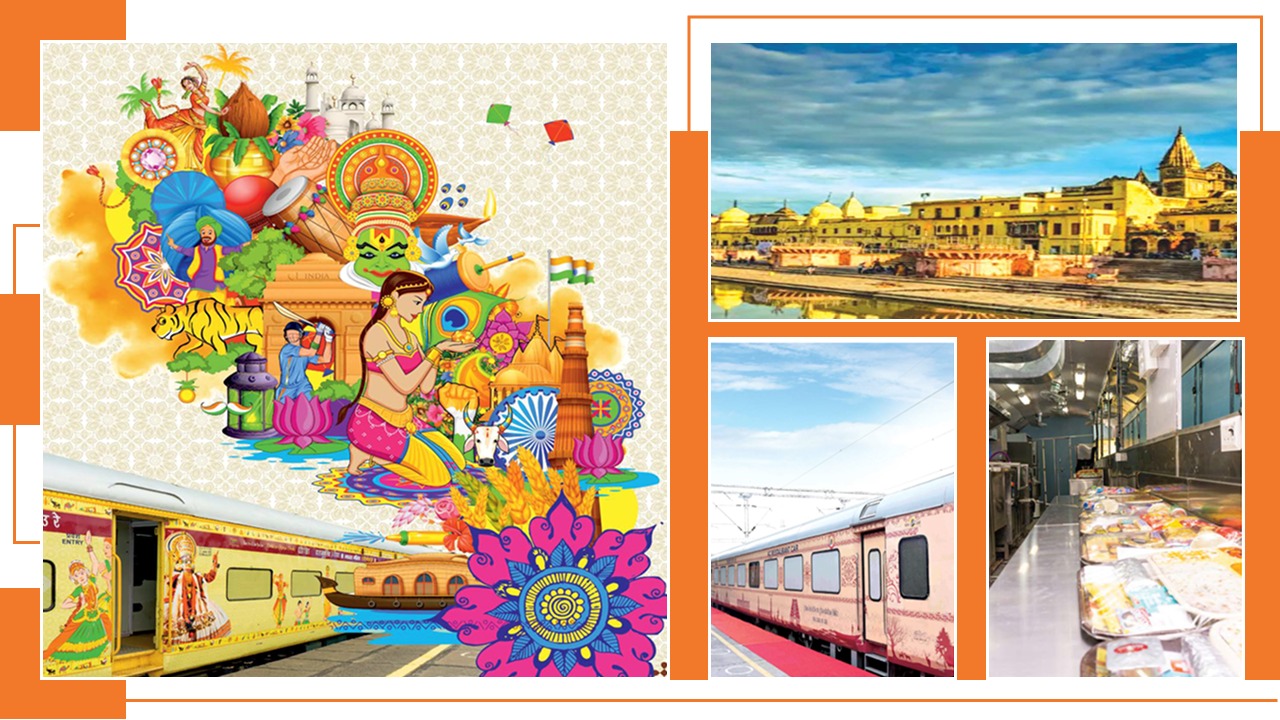
Within that common identity, however, every coach would celebrate a different dimension of India. Inspired by the philosophy beautifully reflected in the Bharat Gaurav brochures, the coaches became moving galleries showcasing India's monuments, architecture, dance traditions, festivals, cuisine, yoga, wildlife, flora and fauna, traditional attire, faith and cultural diversity. Together they created what could truly be called a kaleidoscope of Bharat, travelling across the railway network and introducing passengers to the richness of the country even before they reached their destinations.
One decision made this effort even more meaningful.
Instead of purchasing commercial photographs, we approached State Tourism Departments across the country. I personally interacted with several senior tourism officials while our tourism officers coordinated with many others. The response was overwhelming. States willingly shared their official image libraries because they saw Bharat Gaurav not merely as an IRCTC initiative but as a national platform to showcase their own heritage and tourism potential. The collaboration reduced costs, ensured authenticity and gave every participating State a sense of ownership in the project. The acknowledgements in the Bharat Gaurav brochure stand as testimony to this remarkable spirit of cooperation.
The same philosophy guided the interiors.
Every modification was aimed at making life easier for the tourist. Comfortable seating and sleeping arrangements, improved access for senior citizens, enhanced housekeeping standards, CCTV surveillance, public announcement systems, onboard security, bedroll facilities and carefully planned passenger amenities were introduced to make long journeys comfortable and reassuring.
The pantry car received perhaps the most innovative transformation. We wanted passengers to enjoy fresh, hygienic and hot meals throughout the journey without compromising safety. Working closely with the workshop engineers, Shri Hemant played a pivotal role in conceptualising a modern induction-based flameless kitchen. Every element—from induction cooking ranges and rice boilers to dough kneading machines, roti-making equipment and workflow planning—was examined in detail. The result was a state-of-the-art moving kitchen capable of serving hundreds of passengers efficiently while also offering regional cuisines that matched the preferences of different groups travelling on different circuits.
As the months passed, ideas slowly began taking physical shape.
I still remember the day the first fully branded Bharat Gaurav rake reached Delhi.
As it was slowly crossing the bridge, covered in colours representing the many facets of India, I stood watching silently.
There were tears in my eyes.
What stood before us was no longer a railway rake.
It was the birth of a national tourism brand.
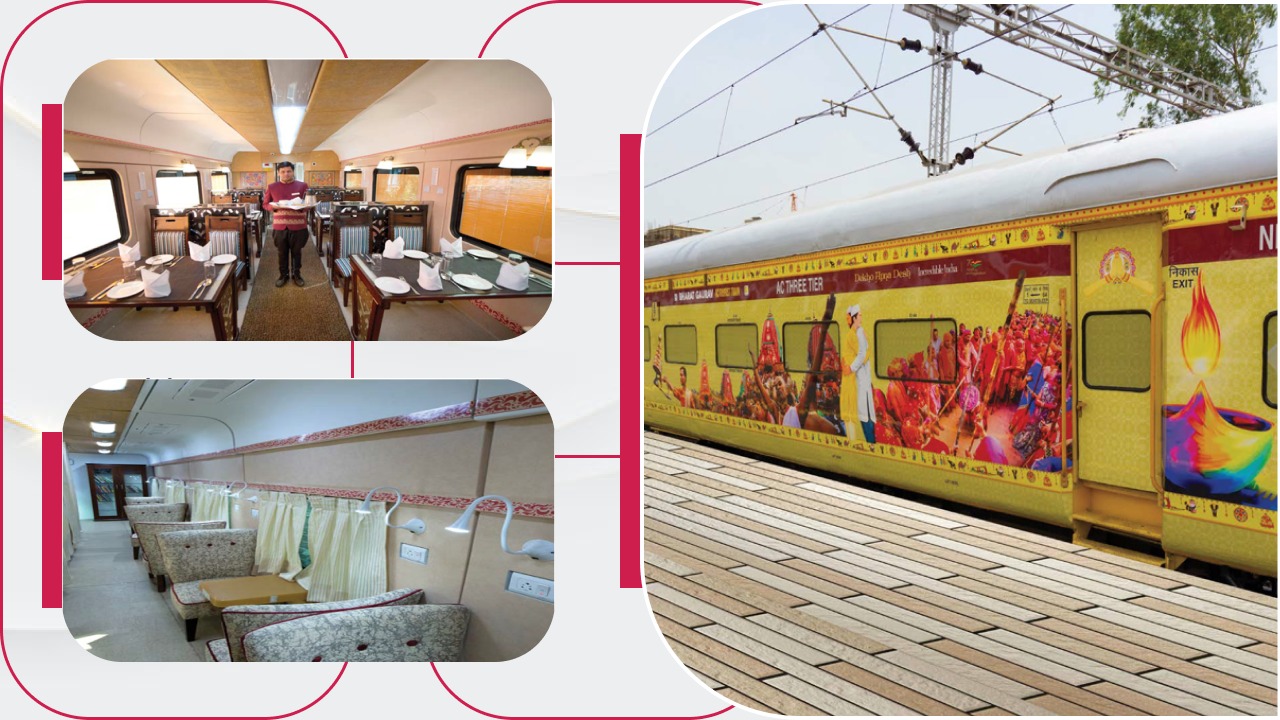
We immediately realised that this journey itself deserved to be documented. That thought led to the creation of the Bharat Gaurav brochures, released during the inauguration of the first Bharat Gaurav itinerary by the Hon'ble Railway Minister. They were much more than promotional publications. They became a permanent record of the vision, teamwork and institutional commitment that had transformed an idea into reality and work was done happily by the same team .
As the Bharat Gaurav trains neared completion, another equally important exercise was unfolding. A beautifully designed train could certainly attract attention, but it would succeed only if it travelled on journeys that touched the hearts of people.
The tourism team therefore devoted considerable effort to identifying the circuits that would define the identity of Bharat Gaurav.
Our approach was never to create random itineraries. Every journey had to be rooted in India's civilisation, culture, spirituality or heritage. Each itinerary had to evoke an emotional connection, inspire confidence among travellers and provide an experience that could not easily be replicated by any other mode of tourism.
The initial portfolio of Bharat Gaurav reflected this philosophy.
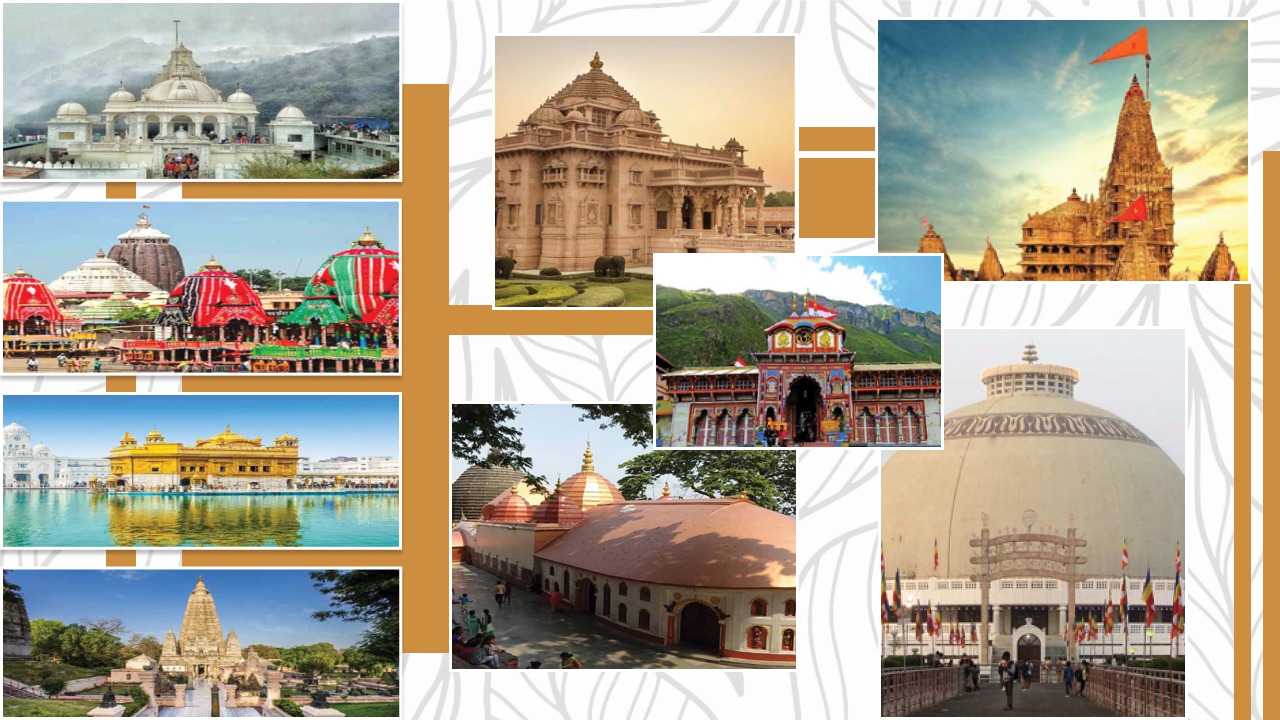
The Jagannath Yatra brought together some of the most sacred pilgrimage destinations in eastern India, covering Varanasi, Baidyanath Dham, Jagannath Puri, Bhubaneswar, Konark and Gaya. The itinerary combined spirituality with architectural heritage, allowing travellers to experience centuries of religious tradition in a single journey.
The Shri Ramayana Yatra soon emerged as one of the flagship offerings of Bharat Gaurav. It was much more than a train tour. It recreated the journey associated with the life of Lord Shri Ram, connecting Ayodhya, Nandigram, Janakpur, Sitamarhi, Buxar, Varanasi, Prayagraj, Shringverpur, Chitrakoot, Nashik, Hampi, Rameswaram, Bhadrachalam and Nagpur. Stretching across multiple states and even extending into Nepal, the itinerary gave devotees an opportunity to experience the Ramayana in a manner that had rarely been attempted through organised tourism. The overwhelming response received for this circuit further reinforced our belief that carefully curated religious tourism had enormous potential in India.
The Tirthankar Jain Circuit was developed to serve the Jain community by connecting the sacred places associated with the lives of the Tirthankars. Destinations such as Ayodhya, Pavapuri, Kundalpur, Rajgir, Parasnath, Varanasi and Sonagir offered pilgrims a spiritually fulfilling journey covering places of birth, enlightenment and liberation of revered Jain saints.
Shikharji temple
Similarly, the Buddhist Circuit Tour brought together Bodhgaya, Rajgir, Nalanda, Sarnath, Lumbini, Kushinagar and Shravasti, allowing travellers from India and abroad to retrace the footsteps of Lord Buddha. The circuit beautifully combined spirituality, history and archaeology, reflecting India's enduring contribution to Buddhist civilisation.
For devotees of Lord Shiva, the Jyotirling Yatra connected some of the country's most revered Jyotirling shrines, including Mahakaleshwar, Omkareshwar, Somnath, Nageshwar, Trimbakeshwar, Grishneshwar and Bhimashankar. The itinerary brought together temples spread across several states into one seamless pilgrimage experience.
Recognising the rich spiritual heritage of Sikhism, the Guru Kirpa Yatra connected the five Takhts and other important Gurudwaras, including Hazur Sahib at Nanded, Harmandir Sahib at Patna, Kesgarh Sahib at Anandpur, Akal Takht at Amritsar and Damdama Sahib. The journey was designed to provide devotees with an organised pilgrimage covering some of the holiest places of the Sikh faith.
The Garvi Gujarat Yatra celebrated the cultural pride of Gujarat by combining spirituality, history and heritage. Destinations such as the Statue of Unity, Champaner, Somnath, Dwarka, Nageshwar, Porbandar and Ahmedabad enabled passengers to experience the remarkable diversity of one state through a single integrated journey.
The Dev Darshan Char Dham Yatra brought together four of the most revered pilgrimage destinations of Hinduism along with other important Jyotirling shrines. Covering Badrinath, Rishikesh, Puri, Rameswaram, Trimbakeshwar, Somnath and Dwarka, it offered pilgrims an opportunity that would otherwise require extensive planning over several independent journeys.
What distinguished these itineraries was not merely the destinations they covered.
While the workshops were preparing the Bharat Gaurav rakes and the tourism team was finalising the itineraries, another equally important exercise was progressing simultaneously—the selection of service providers who would deliver the complete tourism experience onboard and at destinations. This was not a simple procurement exercise; it involved contracting a wide range of specialised services, including onboard hospitality, housekeeping, catering, tour management, local transport and destination support.
Since these services were to be delivered from different base locations across the country, multiple tenders and administrative processes had to be completed within a compressed timeframe. The challenge was to complete every stage of the process in accordance with the prescribed Government procedures while ensuring that the operational readiness of the trains was not delayed.
Time was of the essence. With the earlier Bharat Darshan operations having come to an end, every delay in introducing Bharat Gaurav into service meant a loss of tourism business and revenue for IRCTC. The service contracts, coach preparation, branding, itinerary planning and operational readiness therefore had to move in parallel, with continuous coordination across teams.
We were fortunate to receive encouraging responses from the industry, enabling the selection of competent service partners within the planned schedule. As a result, when the Bharat Gaurav rakes became ready, they could be placed into commercial service without delay, ensuring continuity of operations and allowing the new brand to begin its journey as envisioned.
The response from the market was both encouraging and reassuring. It confirmed that the organisation had correctly understood the aspirations of Indian travellers. More importantly, it demonstrated that Bharat Gaurav was not limited to one train or one circuit. It had the potential to become a platform capable of showcasing the many dimensions of India's civilisation.
Encouraged by the success of the initial circuits, the portfolio gradually expanded. New journeys such as the North East Discovery Tour, Dakshin Bharat Yatra, Divine Triangle Kashi Yatra, Ambedkar Yatra and Uttar Bharat Ki Yatra further strengthened the Bharat Gaurav brand by reaching new regions, new themes and new groups of travellers. Each new itinerary added another chapter to the story of Bharat Gaurav, reaffirming the original vision of showcasing the cultural, spiritual and geographical richness of India through thoughtfully curated rail journeys
When the Bharat Gaurav project was conceived, our objective was to translate the visionary policy of Indian Railways into a professionally managed tourism product that would inspire confidence among travellers, promote India's rich cultural and spiritual heritage, and establish a sustainable model for rail-based tourism.
Looking back today, it is deeply satisfying to see how that vision has evolved.
What began with the commissioning of the first Bharat Gaurav trains has grown into one of the most significant business verticals of IRCTC's Tourism Department. Since the commencement of operations in April 2022, Bharat Gaurav Tourist Trains have successfully operated 629 journeys, carrying more than 4.09 lakh tourists and generating nearly ₹888 crore in revenue during the first four years alone. The growth has been steady and encouraging. From just 15 departures in the inaugural year, operations expanded to 181 journeys in 2023–24, 196 journeys in 2024–25 and 237 journeys in 2025–26. The projected figures for 2026–27 indicate a further increase to 250 departures, serving nearly 1.72 lakh tourists and generating close to ₹395 crore in revenue.
As I approached my superannuation in May 2023, I was conscious that leadership is measured not only by what one creates, but also by what one leaves behind. My endeavour was to ensure that Bharat Gaurav was not seen as a one-time project but as a robust and self-sustaining business vertical with proven systems, established processes, ready rakes, well-defined circuits and a pipeline for future expansion. The earlier Bharat Darshan operations had already come to an end, and it was important that there was no interruption in IRCTC's tourism business. My greatest satisfaction on retirement was the confidence that the new business had been firmly established, providing my successor with a strong platform to introduce new circuits, expand operations and take Bharat Gaurav to even greater heights.
These figures represent much more than commercial success.
Today, Bharat Gaurav has emerged as one of the principal revenue drivers of IRCTC's Tourism business, contributing nearly half of the department's tourism revenue. More importantly, it has demonstrated that thoughtfully designed and professionally managed rail tourism can be commercially sustainable while remaining accessible to ordinary citizens.
The experience and institutional capabilities developed through Bharat Gaurav have also enabled IRCTC to extend its services beyond its own operations. Several State Governments now partner with IRCTC for operating State Teerth Special trains under various social welfare programmes, enabling senior citizens and economically weaker sections of society to undertake pilgrimages and cultural journeys with comfort, dignity and professional management. The systems, operational expertise and organisational confidence developed through Bharat Gaurav have made these initiatives possible.
The significance of Bharat Gaurav, however, goes far beyond numbers and revenue.The project has become a meaningful contributor to two important national initiatives.
By encouraging Indians to travel beyond their own states and experience the country's diverse traditions, faiths, cuisines, languages, architecture and cultural heritage, Bharat Gaurav gives practical expression to the Government of India's vision of "Ek Bharat Shreshtha Bharat."on one hand and at the same time, every itinerary reinforces the Ministry of Tourism's inspiring message of "Dekho Apna Desh." Whether travelling on the Shri Ramayana Yatra, the Buddhist Circuit, the Jyotirling Yatra, the Char Dham pilgrimage, the Guru Kirpa Yatra, the Garvi Gujarat circuit or exploring the North East, passengers are encouraged to rediscover the richness of their own country through experiences that combine spirituality, history, culture and heritage.
Perhaps that is the greatest achievement of Bharat Gaurav.We know that The trains do not merely connect destinations.
I see the vision of Indian Railways, the commitment of IRCTC, the dedication of countless officers, engineers, tourism professionals, workshop teams, designers, State Tourism Departments and partners who believed that together we could create something extraordinary. Above all, I see the trust placed in us by lakhs of passengers who chose to travel with Bharat Gaurav and made it a part of their own memories.Its legacy will not be measured only by the number of trains operated or the revenue generated.
It will be measured by the millions of memories created, the heritage celebrated, the faith strengthened and the countless Indians who have rediscovered their own country through a journey called Bharat Gaurav.