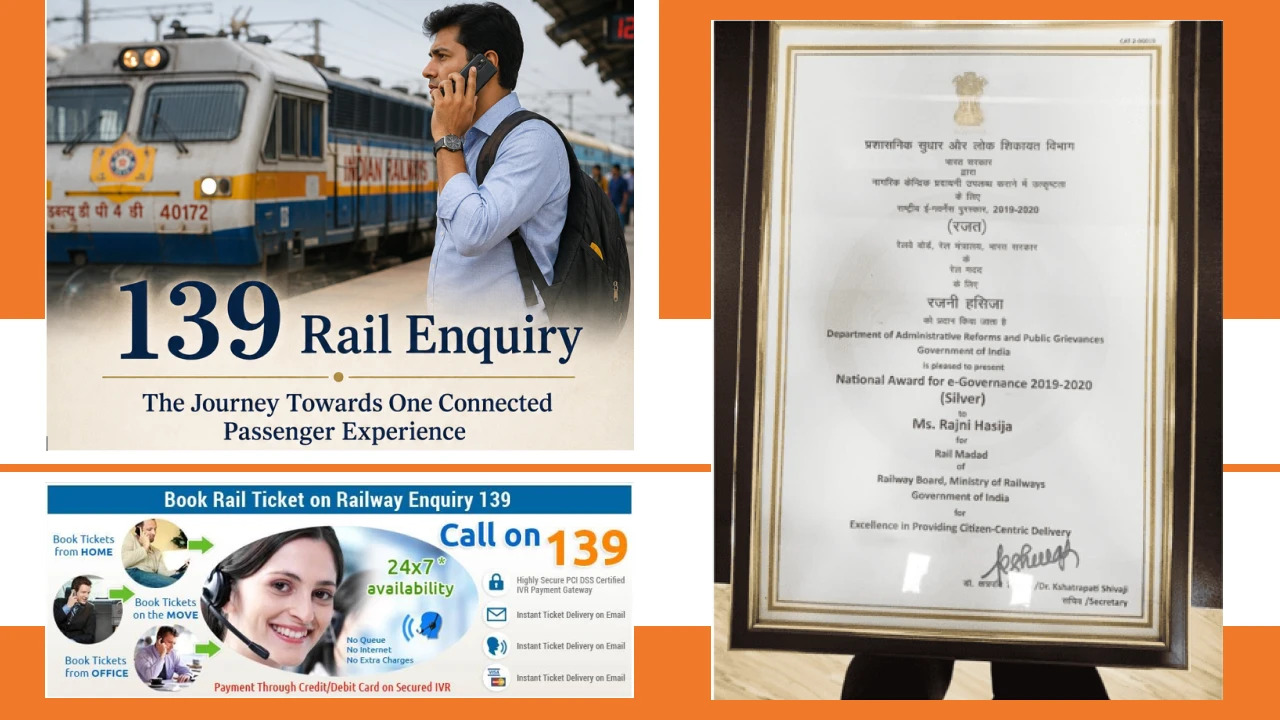
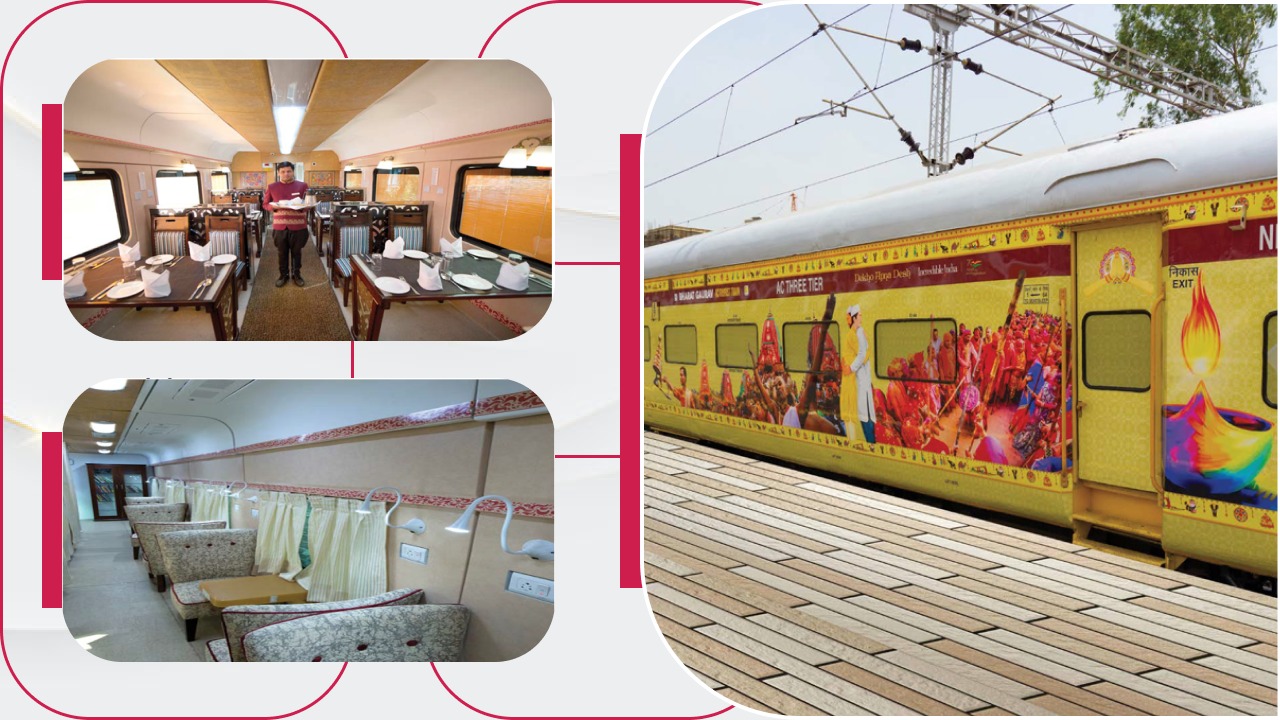
"Every railway journey begins long before a passenger boards a train. It begins with information."
For millions of passengers, a railway enquiry is often the very first interaction with Indian Railways. Accurate information builds confidence, reduces uncertainty and shapes the travel experience even before the journey begins.
Today, dialing 139 is second nature to railway passengers. Few pause to think about the vision, institutional collaboration and years of dedicated effort that transformed multiple independent enquiry systems into one trusted national passenger interface.
This Leadership Chronicle is not the story of a telephone number.
It is the story of how a shared vision of the Ministry of Railways was translated into a nationwide public service through the collective efforts of Indian Railways, IRCTC, CRIS, technology partners and countless professionals. It is a story of collaboration across institutions, commercial innovation, technological transformation and an unwavering commitment to improving passenger services.
Over nearly two decades, the platform evolved continuously—adapting to changing technologies, changing passenger expectations and changing public service priorities. From a railway enquiry service to an integrated passenger assistance platform powered by Artificial Intelligence, the journey reflects how public institutions can innovate while remaining true to their purpose.
This Chronicle does not attempt to document every technical detail or every administrative decision. Instead, it captures the leadership lessons behind one of Indian Railways' most significant passenger service transformations—lessons in vision, execution, collaboration, resilience and continuous reinvention.
Ultimately, this is the story of a shared belief that technology should simplify public service, institutions should work together rather than in silos, and every innovation should make life a little easier for the people it serves.
Because every connected railway journey begins with one connected passenger experience.
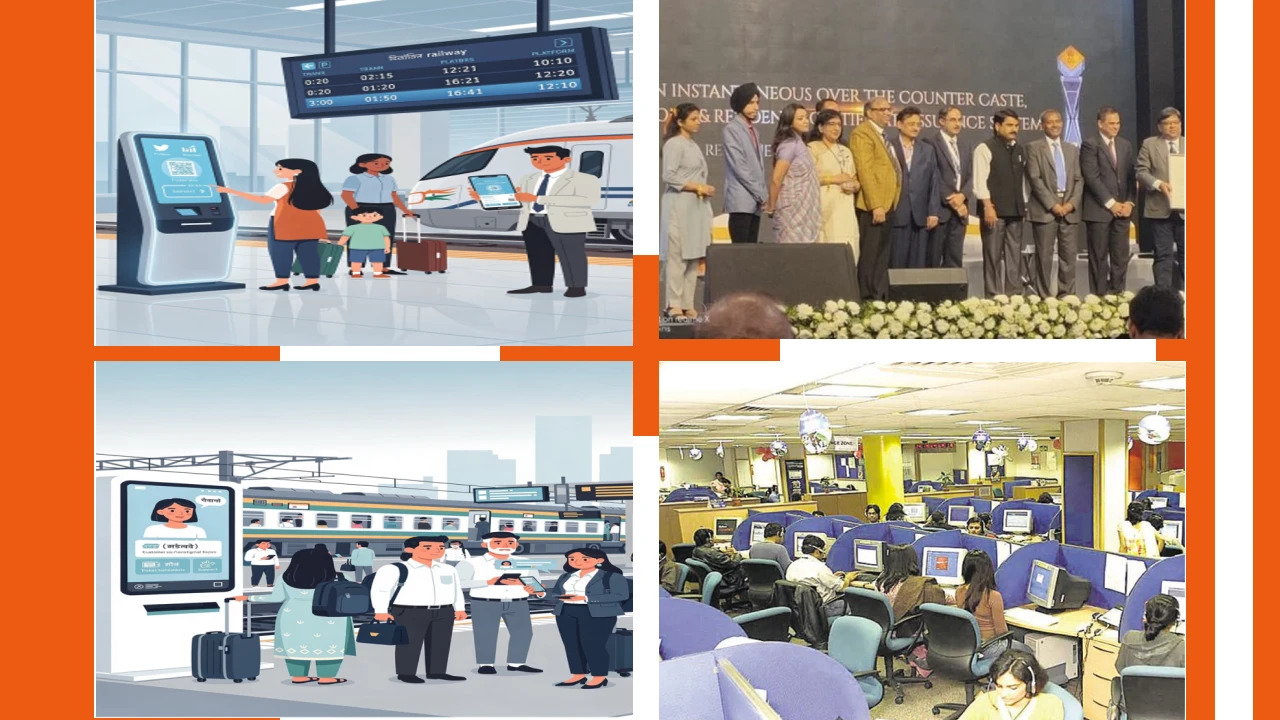
Episode 1 – A New Chapter in Passenger Service
By 2005–06, Indian Railways had already established itself as one of the world's largest railway networks. Every day, thousands of trains connected millions of passengers across the country through an extensive network of stations. More than six billion passengers travelled on the system annually, making Indian Railways one of the world's busiest transportation networks and one of the largest public service organisations in the world.
Behind these impressive numbers was one common expectation. Whether travelling for work, education, business, healthcare or to meet loved ones, every passenger looked for authentic and timely information about the journey. Passenger service had always been at the heart of Indian Railways, and providing reliable travel information was an integral part of that commitment.
As passenger volumes continued to grow and technology evolved, new opportunities emerged to make these services even more accessible and convenient. Interactive Voice Response Systems (IVRS), centralised contact centres and integrated information platforms were beginning to transform customer service across many sectors. Indian Railways recognised that these developments offered an opportunity to further strengthen passenger enquiry services and enhance the overall travel experience.
The objective was never to replace the existing enquiry arrangements that had served passengers over the years. Instead, the vision was to build upon those strengths by creating a unified, technology-enabled platform through which authentic railway information could be accessed through a single, easy-to-remember national interface.
It was an idea that reflected the very character of Indian Railways—continuously evolving to meet the changing needs of the nation while preserving the trust that generations of passengers had placed in it.
The journey had begun.
Episode 2 – One Vision, Many Institutions
"Some transformations are too large for any one organisation to deliver alone. They require a shared vision, clearly defined responsibilities and the collective strength of institutions working towards a common purpose."
By 2006, the Ministry of Railways had recognised the opportunity to transform passenger enquiry services through technology. The vision was ambitious—to create an integrated, nationwide enquiry system that would make authentic railway information easily accessible while preserving the reliability and trust that passengers associated with Indian Railways.
Turning that vision into reality, however, required capabilities that no single organisation could provide on its own. The project demanded technological expertise, commercial innovation, operational excellence and continuous institutional coordination. It therefore became a collaborative initiative in which every organisation contributed its distinctive strength.
CRIS, as the technology arm of Indian Railways, was entrusted with developing the system architecture and integrating it with core railway applications such as PRS and NTES. This ensured that the information reaching passengers originated from authentic railway databases and evolved in step with the broader digital transformation of Indian Railways.
At the same time, the project required a commercially sustainable Public–Private Partnership (PPP) model. During that period, such large-scale PPP initiatives within the railway ecosystem were still relatively new. They demanded commercial flexibility, long-term planning and close engagement with the private sector—areas that extended beyond the conventional role of a government department.
IRCTC was therefore entrusted with leading the implementation of the project under the PPP framework. Its responsibility went far beyond awarding a contract. It designed the commercial architecture, selected the service partner through a transparent tendering process, coordinated multiple stakeholders and closely monitored implementation to ensure that the project fulfilled the vision of the Ministry of Railways.
The operational responsibility rested with the Rail Enquiry Franchisee. Through the consortium comprising Bharat BPO, Spanco Telesystems & Solutions Ltd., Stracon Back Office Solutions Ltd. and BSNL, the nationwide infrastructure, regional hubs, call centres and supporting technology were established and operated.
One of the defining features of the project was its governance. Regular review meetings brought together representatives of the Ministry of Railways, Railway Board, IRCTC, CRIS and the service partner. These discussions addressed not only implementation milestones but also policy decisions, system design, migration from existing enquiry arrangements and the creation of a robust infrastructure capable of serving millions of passengers across the country.
The project also reflected a forward-looking financial philosophy. The objective was to create a national passenger enquiry service without requiring capital investment from either Indian Railways or IRCTC. The private partner invested in the infrastructure and operations under a long-term licence, with the expectation that revenues would gradually accrue over the project period through the agreed commercial model. The revenue-sharing arrangement was designed not merely to generate income for IRCTC, but also to support project monitoring and progressively reduce the expenditure associated with traditional manual enquiry services. It was a long-gestation model that balanced public service objectives with commercial sustainability.
Looking back, the greatest strength of the project was not the technology, the contract or the infrastructure. It was the willingness of multiple institutions to contribute their respective strengths towards a shared purpose. That collaborative spirit became the foundation upon which the entire journey of 139 Rail Enquiry was built.
Episode 3 – Building a Nationwide Service
"A vision inspires. Execution transforms. The true test of leadership begins when an idea starts serving people."
With the institutional framework established and the responsibilities clearly defined, the next challenge was execution. Following a transparent competitive bidding process, IRCTC awarded the contract for establishing the Integrated Railway Enquiry System on 1 December 2006. The award of the contract was not the conclusion of the project—it marked the beginning of one of the most ambitious passenger service implementation programmes undertaken by Indian Railways.
The vision now had to be transformed into a dependable national service capable of handling millions of passenger enquiries across the country. Success depended on executing several critical activities simultaneously. Infrastructure had to be created, technology had to be integrated, telecom connectivity had to be established, systems had to be tested and, above all, people had to be prepared before a single passenger call could be answered.
The first priority was to establish the physical and technological foundation of the project. Under the Public–Private Partnership framework, the service partner was responsible for creating the entire operational infrastructure at its own cost. Four regional hubs were established across the country, each designed as a modern contact centre equipped with telecommunications infrastructure, servers, networking equipment and specialised software capable of supporting a nationwide enquiry service.
While the physical infrastructure was taking shape, another equally important activity was progressing in parallel. The 139 short code had to be activated across telecom networks throughout the country. Every telecom exchange had to recognise the number and correctly route passenger calls to the designated regional hub. This required close coordination between the telecom service providers, BSNL, the technology teams and the railway organisations. The successful establishment of nationwide connectivity was one of the most critical milestones in making a single railway enquiry number accessible across India.
Technology integration presented another major challenge. The enquiry platform developed by the service provider had to communicate seamlessly with the railway information systems developed by CRIS. Both teams worked together to develop the interfaces through which authentic railway information could flow accurately and securely between the systems. Every interface was carefully designed, tested and validated before the platform was commissioned.
No national passenger service can depend on assumptions. Hundreds of test cases were therefore created to validate every category of passenger enquiry. Each response—whether relating to PNR status, train schedules, fares or train running information—was repeatedly tested to ensure that the information reaching passengers was accurate, dependable and consistent before the system was opened to the public.
Yet, technology and infrastructure alone could never make 139 Rail Enquiry successful.
The real strength of the project had to come from its people.
The customer service executives recruited by the service provider came primarily from the BPO industry. They possessed excellent communication skills and were familiar with modern customer service practices, but they had little exposure to the specialised working of Indian Railways. Railway terminology, reservation procedures, train operations, passenger expectations and enquiry handling required an entirely different level of domain knowledge.
Bridging this gap became one of the most significant leadership challenges of the project.
IRCTC therefore adopted a unique training approach by drawing upon the expertise already available within Indian Railways. Experienced Chief Reservation Supervisors, enquiry staff and other railway professionals who had spent years serving passengers became the first mentors for the new workforce. Faculty members from the Zonal Railway Training Schools were also engaged to develop and deliver structured training programmes. Together, they created a comprehensive training module covering railway terminology, reservation procedures, passenger services, enquiry handling, customer behaviour and the practical use of railway information systems.
This became the foundation of a "Train the Trainer" programme. The first batch of trainers was prepared jointly by railway experts and the project team. These trainers subsequently trained successive batches of customer service executives across the four regional hubs, ensuring consistency in knowledge, professionalism and service standards.
The transformation that followed was remarkable. It successfully blended the deep operational knowledge of Indian Railways with the responsiveness, communication skills and customer-centric approach of the BPO industry. Rather than replacing one culture with another, the project combined the strengths of both to create a new generation of railway customer service professionals.
Supporting this transformation was a specially designed Customer Relationship Management (CRM) application developed by Spanco. Instead of depending solely on personal memory or manual references, customer service executives could retrieve authentic railway information through an integrated digital platform and respond to passengers quickly and confidently. The technology empowered the agents, while the training ensured that technology was used with understanding, accuracy and empathy.
The final stage was commissioning. The first Rail Sampark 139 service was inaugurated by the then Hon'ble Railway Minister from the premises of Rail Bhavan. It was a moment of anticipation for everyone associated with the project. Months of planning, infrastructure development, technology integration, testing and training were now about to be tested before the nation.
To demonstrate the service, the Hon'ble Minister placed the first call to 139. The call was answered by a lady customer service executive, who handled the enquiry with confidence, professionalism and ease. Looking towards the packed hall filled with journalists, the Minister smiled and remarked that perhaps the operator recognised his number. He decided to place another call. Once again, the call was answered promptly and professionally. The hall erupted in applause.
It was a simple moment, yet one that symbolised months of meticulous preparation. Behind that effortless conversation lay the coordinated efforts of multiple institutions, the dedication of hundreds of professionals and the confidence that comes only from disciplined execution. At that moment, the vision of an integrated national railway enquiry service had truly become a reality.
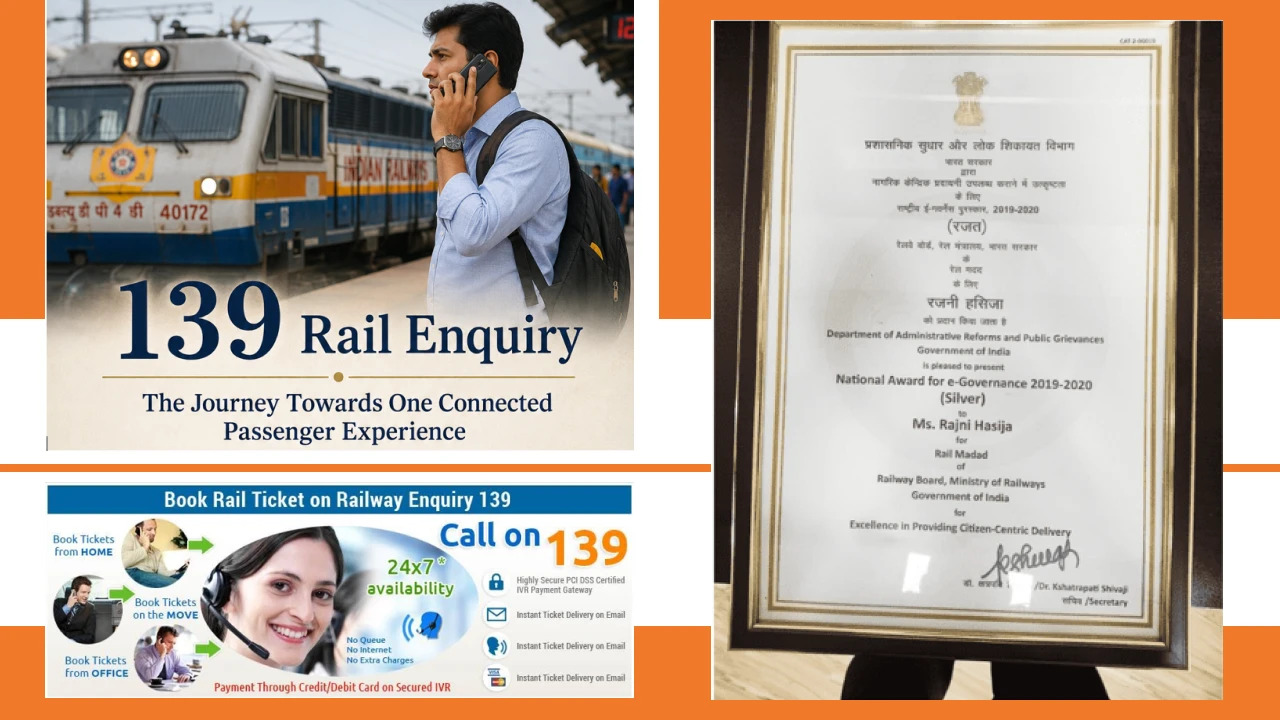
Episode 4 – Making the Vision Sustainable
"A vision can inspire change. But unless it is supported by a sustainable model, even the most promising public initiative struggles to endure."
By the time the four regional hubs were ready and Rail Sampark 139 was prepared for launch, one question remained at the centre of every discussion:
How could such a large passenger service be sustained without becoming a recurring financial burden on Indian Railways?
Traditionally, passenger enquiry had always been viewed as a public service expenditure. Every enquiry required investment in infrastructure, manpower and operations. The challenge before the project team was therefore not merely to establish a nationwide enquiry system, but to create a model that could sustain itself while continuing to deliver high-quality passenger services.
IRCTC addressed this challenge by designing an innovative Public–Private Partnership (PPP) framework, which was relatively uncommon for public-sector service delivery at that time. Instead of investing public funds in creating a nationwide contact centre infrastructure, the selected service provider was required to establish the entire operational ecosystem—including call centres, technology platforms, telecommunications infrastructure and trained manpower—at its own cost. Revenue generated through passenger calls and value-added services would sustain the project, creating a framework in which both public service and commercial viability could coexist.
The commercial architecture itself reflected the collaborative nature of the project. BSNL was identified as the telecom partner on a non-exclusive basis, while the operational consortium combined expertise in telecommunications and business process management through dedicated project entities. This arrangement enabled Indian Railways and IRCTC to deal with a single implementation agency while drawing upon the specialised capabilities of multiple organisations.
Designing the model, however, proved easier than implementing it.
Although the infrastructure was ready and the regional hubs became operational on schedule, the commercial ecosystem required to support the project took much longer to mature. Separate agreements had to be negotiated with telecom service providers across the country. Many of them questioned the need to share a portion of their telecom revenues for a railway enquiry service. At that stage, the regulatory framework governing telecom revenue sharing was still evolving, and each discussion demanded careful persuasion, patience and continuous engagement.
As a result, while the service infrastructure had already begun functioning, the anticipated revenue streams were slow to materialise. The project had started incurring operational expenditure long before its commercial foundations became fully established. Call centres had to function, trained manpower had to be retained and service quality had to be maintained—even though the revenue model was yet to reach its intended scale.
One important milestone still remained.
The nationwide short code 139 had to be activated.
Without it, passengers would not enjoy the convenience of a single, easy-to-remember railway enquiry number for SMS
A crucial meeting was scheduled with the Joint Secretary in the Ministry of Communications to secure the necessary approvals. On the appointed day, Delhi witnessed torrential rain. Roads were flooded, traffic came to a standstill and reaching the Ministry itself became a challenge.
As the officer coordinating the project, I knew postponing the meeting would delay the implementation of a service that thousands of people had worked tirelessly to build. Completely drenched by the rain but determined to honour the commitment, I reached the Ministry as scheduled.
The Joint Secretary was visibly surprised to see the condition in which I had arrived. After discussing the significance of the project and the urgency of operationalising the national short code, the approval was granted the very same evening.
For many, it may have appeared to be a routine administrative decision.
For the project team, it marked one of the defining milestones in the journey of Rail Sampark 139.
Without 139, there could be no truly national passenger enquiry service.
Gradually, the commercial framework also began to stabilise. SMS-based services and value-added services were introduced, creating additional revenue streams that strengthened the project's financial sustainability. Some services originally planned under a separate short code had to be temporarily accommodated within 139 until the required approvals were received. These pragmatic decisions ensured that the project continued moving forward without compromising its long-term vision.
Looking back, the greatest achievement of this phase was not merely the creation of an innovative revenue model. It was the determination of every stakeholder to ensure that the service succeeded despite commercial uncertainties. The project survived because institutions, partners and individuals remained committed to a common purpose.
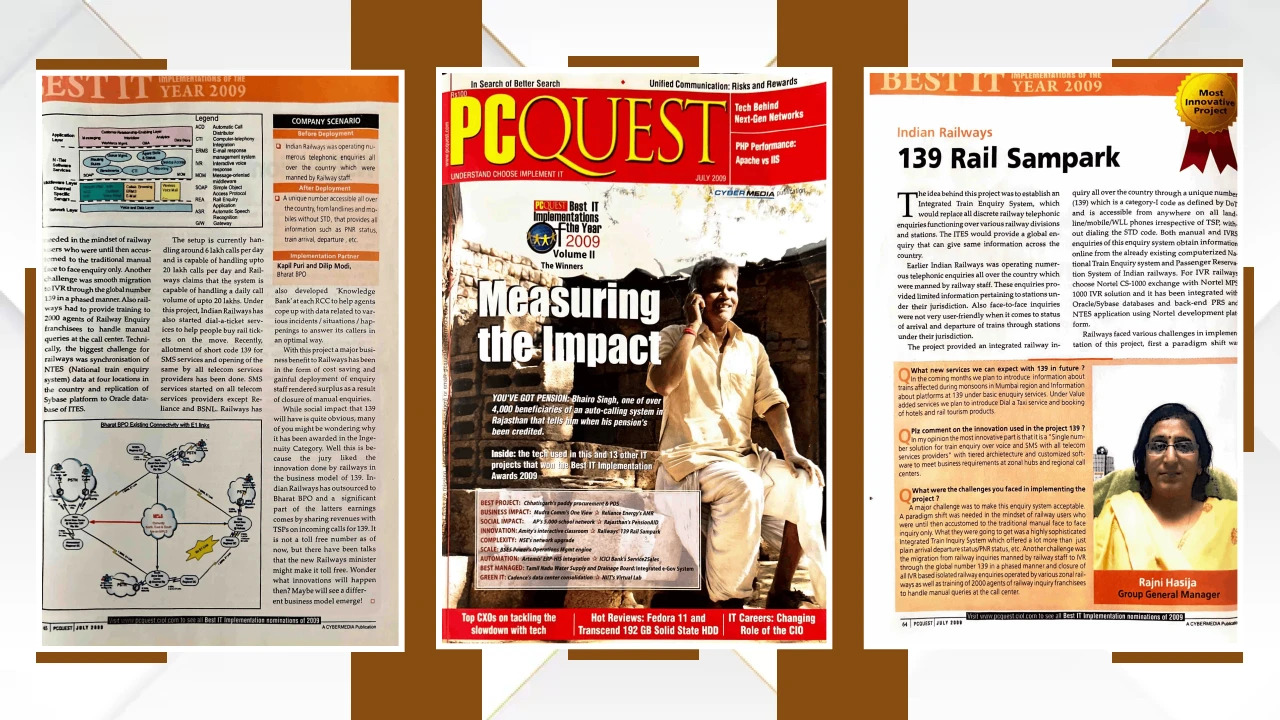
The innovative commercial framework behind Rail Sampark 139 also received wider recognition. Its revenue-sharing model, which combined public purpose with commercial sustainability, was honoured with the PC Quest Best Business Model Award, validating the project's pioneering approach to public-sector innovation.
Episode 5 – Building Trust in Information
"Technology can connect people. Only reliable information earns their trust."
With the successful rollout of Rail Sampark 139 across the country, passengers now had a single national number for railway enquiries. The infrastructure was in place, trained customer service executives were answering calls and the system was handling an ever-growing volume of passenger enquiries.
The next challenge, however, lay beyond infrastructure and technology.
It was information.
Passengers did not judge the quality of the service by the sophistication of the technology behind it. They judged it by one simple question:
"Was the information correct?"
Providing authentic railway information required seamless coordination with the operational systems of Indian Railways. While Passenger Reservation System (PRS) data was largely structured, real-time train running information depended upon the National Train Enquiry System (NTES), which itself was undergoing rapid development during those years.
In the initial stages, train running information was not available electronically from every railway division. Several locations still relied upon manual data entry before the information became available through NTES. Consequently, if a train's movement had not yet been updated, the enquiry platform could only provide the latest information available in the system. The challenge, therefore, was not the capability of Rail Sampark 139, but the maturity of the underlying information ecosystem on which it depended.
This was recognised by the Ministry of Railways as a larger institutional challenge. Continuous efforts were undertaken to strengthen the quality, speed and reliability of train-running information across the railway network. As NTES evolved and its integration with operational applications improved, the quality of information available to Rail Sampark 139 also improved significantly.
Over time, CRIS further strengthened the technological backbone by integrating NTES with the Control Chart applications maintained by Indian Railways. Instead of depending solely upon isolated updates, passenger information increasingly flowed through interconnected railway systems, creating a more reliable and consistent source of information. The enquiry platform evolved alongside these technological improvements, ensuring that passengers benefited from every enhancement made within the larger railway information ecosystem.
One of the most important lessons from this period was that technology alone does not create trust.
Trust is created when technology, operational discipline and accurate information work together.
The project team continuously reviewed passenger feedback, monitored recurring issues and worked closely with CRIS and railway operating departments to improve the quality of information reaching passengers. Every improvement made in the backend systems directly enhanced the confidence that passengers placed in the 139 service.
Independent studies conducted during this period reinforced this growing public confidence. A customer satisfaction survey by Nielsen observed that Rail Sampark 139 had emerged as an important source of railway information and enjoyed a high degree of dependability and acceptability among passengers. The study also highlighted an interesting behavioural insight: while passengers appreciated the convenience of IVRS, many still preferred speaking with a customer service executive when seeking guidance on more complex travel situations. Rather than replacing people with technology, Rail Sampark 139 successfully combined both, allowing automation and human interaction to complement each other.
Looking back, this phase represented much more than an improvement in information systems. It demonstrated how large public institutions evolve. As operational systems matured, passenger services matured alongside them. Every enhancement made within Indian Railways strengthened the service delivered through 139, and every improvement in 139 further reinforced passenger confidence in the railway system.
The platform was no longer simply answering questions.
It was beginning to earn the trust of millions of passengers.
Episode 6 – Building on Success
to entrust it with an even greater responsibility."
By the end of its first decade, Rail Sampark 139 had firmly established itself as one of the most trusted passenger interfaces of Indian Railways. Millions of passengers across the country depended upon a single national number for authentic railway information. The platform had proved its reliability, the operating model had matured, and the institutional collaboration behind it had demonstrated its effectiveness.
During the same period, the Government's vision for passenger service was also evolving. The focus was no longer limited to providing information alone. Increasing emphasis was being placed on timely grievance redressal, emergency assistance and delivering a seamless passenger experience through integrated digital services.
Instead of developing another independent platform for these services, Indian Railways adopted a more thoughtful approach. It decided to build upon a system that had already earned the confidence of millions of passengers.
Accordingly, RailMadad was integrated with the established 139 platform, bringing together passenger enquiries, complaints, medical and security emergencies, assistance for women and Divyangjan passengers, refund-related issues and other passenger support services through a single national interface. This represented a significant shift in the philosophy of passenger service. What had begun as a railway enquiry service was now evolving into an integrated passenger assistance platform.
The integration involved much more than a technological enhancement. Operational workflows had to be redesigned, responsibilities had to be redefined and coordination across multiple railway departments had to be strengthened. A fresh commercial arrangement was also developed under which Indian Railways supported the expanded scope of work through IRCTC, enabling the implementation partner to manage the enhanced responsibilities while maintaining service quality.
What made this transformation particularly significant was that it did not discard a successful system in favour of a new one. Instead, it recognised the strength of an existing national platform and expanded its role to meet the changing expectations of passengers. The infrastructure, operational experience and institutional learning developed through Rail Sampark 139 became the foundation for the next phase of digital passenger services.
The successful integration of RailMadad with the established 139 platform was later recognised with the National e-Governance Award, acknowledging its contribution to citizen-centric digital governance and integrated passenger services. The recognition reflected the collective efforts of the Ministry of Railways, Indian Railways, IRCTC, CRIS, the implementation partner and the many professionals whose dedication made this transformation possible.
Looking back, this phase demonstrated one of the most enduring principles of public-sector innovation. Lasting transformation is rarely achieved by creating entirely new systems. More often, it is achieved by strengthening trusted institutions, building upon proven platforms and allowing successful initiatives to evolve with the changing needs of society.
Episode 7 – Reinventing for the Future
The success of a public institution is measured not by how long it preserves an old system, but by how confidently it prepares for the future."
For more than fifteen years, Rail Sampark 139 had remained the trusted voice of Indian Railways for millions of passengers. It had successfully evolved from a railway enquiry service into an integrated passenger assistance platform through the integration of RailMadad. The vision that had guided its creation in 2006 had stood the test of time.
However, the world around it had changed.
The commercial model that had sustained the project for over a decade was built on the realities of the telecom industry that existed in 2006. Revenue from passenger calls and SMS services had enabled the service provider to recover its investment while delivering a nationwide enquiry service. For many years, this model proved both innovative and sustainable.
Gradually, however, the telecommunications landscape underwent a fundamental transformation. Increasing competition, changing customer behaviour and the rapid growth of digital communication significantly reduced the revenues that had originally sustained the project. The very factors that had once made the business model successful were no longer available.
The challenge was not that the original model had failed.
The challenge was that the environment in which it had been designed had changed completely.
Indian Railways therefore took a strategic decision to redesign the service for the next phase of its evolution.
The most significant change was not technological—it was philosophical.
The earlier revenue-based model was replaced by an expenditure-based model, recognising that passenger enquiry and assistance had become an essential public service. Instead of recovering costs through passenger calls and SMS services, the expenditure for operating the service would now be borne by Indian Railways, while the implementation partner would be compensated for delivering defined service standards.
This shift also created an opportunity to adopt technologies that had not been available when Rail Sampark 139 was first launched. The new Integrated Railway Helpline and Enquiry System (IRHES–139 RailMadad) moved to a cloud-based architecture, providing greater scalability, resilience and operational flexibility. At the same time, Artificial Intelligence transformed the passenger experience.
One of the most significant improvements was the introduction of conversational Automatic Speech Recognition (ASR) powered by Natural Language Processing and Natural Language Understanding. Unlike the earlier IVRS, which depended primarily on keypad inputs, passengers could now interact with the system naturally through speech. Nearly 85% of passenger interactions could be handled automatically, allowing customer service executives to focus on more complex issues requiring human intervention.
The new platform also introduced multilingual support across thirteen Indian languages, cloud-hosted operations from two centres, defined Service Level Agreements, significantly lower call waiting times and improved integration with major railway applications through modern APIs. Although the technology had changed dramatically, one thing remained familiar to passengers—the trusted number 139.
Looking back, the transition represented much more than the replacement of one technology by another. It reflected the willingness of Indian Railways to continuously modernise its passenger services while preserving the confidence that millions of passengers had already placed in the platform.
The technology changed.
The business model changed.
The purpose never did.
Episode 8 – A Legacy That Continues
Rail Sampark 139 is much more than the story of a railway enquiry service.It is the story of how a shared vision evolved over nearly two decades to continuously improve passenger services through technology, collaboration and institutional commitment.
As I look back in 2026, I feel privileged to have witnessed this journey during two significant phases of my professional life—from 2006 to 2010 and again from 2014 to 2023. More importantly, I feel proud that this platform continues to serve millions of passengers, constantly adapting to new technologies and changing expectations.
No project of this scale is ever the work of one individual. Its success reflects the collective efforts of the Ministry of Railways, Indian Railways, IRCTC, CRIS, our implementation partners, telecom operators and countless railway professionals who worked together with a shared purpose. As the platform evolved, new partners carried the journey forward with the same commitment, strengthening what had already been built.
If this journey leaves behind one lesson, it is this:
Great public institutions are built through collective commitment. Their greatest legacy is not the projects they complete, but the trust they continue to inspire and the value they continue to create for society.