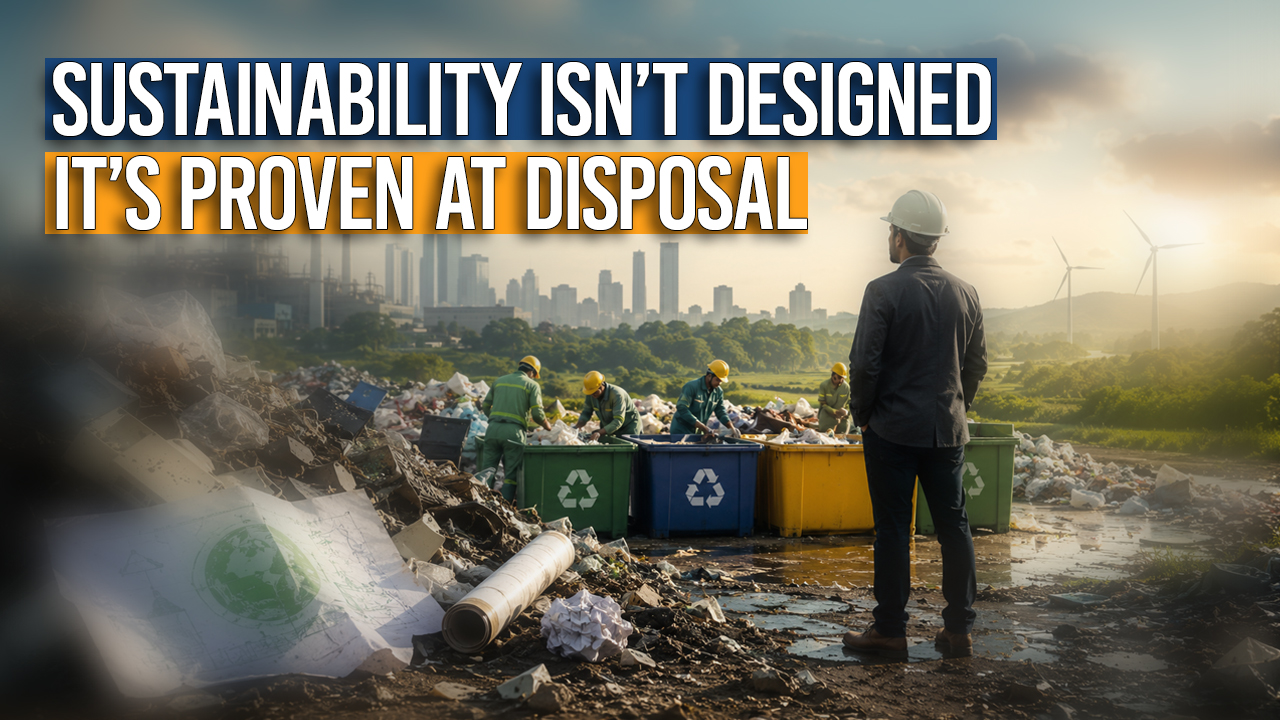
Sustainability Isn’t Designed, It’s Proven At Disposal
In today’s business landscape, sustainability has become a central narrative. Labels such as “recyclable,” “eco-friendly,” and “sustainable packaging” are now common across products, corporate disclosures, and brand communications. These terms are meant to signal environmental responsibility but they often mask a deeper, systemic gap.
At the heart of this issue lies a simple but critical truth:
Sustainability cannot be claimed at the design stage, it must be proven at the point of disposal.
This distinction is particularly important in the context of plastic waste, where the difference between “recyclable” and “recycled” is not just semantic, it reflects a structural disconnect between intent and outcome.
The Illusion of Recyclability
A recent case from Hyderabad illustrates this gap vividly. A plastic scrap aggregation initiative reportedly collected nearly one crore courier plastic bags in just three months. These bags came from well-known brands and were all labelled “recyclable.”
Yet, despite this claim, not a single recycler was willing to process them.
The reason is straightforward. These courier bags are typically made of multi-layer, multi-colour plastic films combined with adhesives and labels. While technically recyclable under controlled conditions, they are:
- Economically unviable
- Operationally difficult to process
- Incompatible with existing recycling infrastructure
Even minor design elements like adhesive labels can render such materials non-processable at scale.
This highlights a crucial distinction:
- “Recyclable” is a theoretical property
- “Recycled” is a real-world outcome
The gap between the two is not accidental, it is systemic.
A Lifecycle View of Sustainability
From a sustainability and ESG perspective, this gap represents a classic case of implementation risk. Frameworks aligned with lifecycle thinking such as those referenced by the CFA Institute emphasize that environmental claims must be evaluated across the full lifecycle of a product.
This includes:
- Material composition
- Collection systems
- Segregation efficiency
- Economic viability
- Processing feasibility
If any one of these elements fails, the sustainability claim weakens.
In other words, design alone does not determine sustainability systems do.
India’s Plastic Waste Reality
India’s plastic waste challenge reflects this disconnect at scale.
- The Central Pollution Control Board estimated plastic waste generation at around 3.4 million tonnes in 2019–20
- Recent estimates place this closer to 9 million tonnes annually
- Packaging accounts for 50–60% of total plastic use (India Plastics Pact)
India’s reported recycling rate often cited between 40–60% appears strong compared to the global average of roughly 9%, as highlighted by the Organisation for Economic Co-operation and Development.
However, these numbers require context.
A significant portion of recycling in India includes:
- Downcycling into lower-value products
- Informal sector processing
- Exclusion of low-value plastics
When these factors are considered, effective recycling especially for multi-layer and low-value plastics is far lower than reported figures suggest.
Economics, Not Labels, Drives Recycling
India’s recycling ecosystem is largely informal and driven by economics:
- High-value plastics (like PET bottles) are actively collected and recycled
- Low-value plastics (like multi-layer films) are often ignored
This creates a structural exclusion where certain materials, despite being labelled recyclable, never enter the recycling chain.
Recent developments reinforce this reality:
- Urban clean-up efforts have found large volumes of low-value plastics accumulating in lakes and ecosystems
- Cities like Bengaluru are increasingly diverting such waste to co-processing (used as fuel), rather than true recycling
- Even small design elements such as bottle caps continue to evade effective recovery
The conclusion is clear: recyclability without recoverability has limited environmental value.
EPR: Progress with Limitations
India’s Extended Producer Responsibility (EPR) framework represents an important regulatory shift. Led by the Central Pollution Control Board, the system aims to:
- Register producers and brand owners
- Set recycling targets
- Track compliance through an EPR portal
The intent is to ensure accountability for post-consumer waste.
However, implementation is still evolving.
In practice, compliance is often:
- Certificate-driven (via EPR credits)
- Less focused on physical traceability and actual recovery
This reflects a transition phase where regulatory intent is strong, but ecosystem alignment is still catching up.
The ESG Disclosure Gap
Corporate ESG disclosures today demonstrate growing awareness. Companies report:
- Percentage of recyclable packaging
- EPR compliance
- Sustainability commitments
But a critical gap remains.
- “Recyclable” reflects technical feasibility, not real-world outcomes
- Compliance may rely on credit mechanisms, not actual material recovery
- Disclosures rarely capture end-of-life performance
This creates a perception gap where sustainability is measured at design, rather than validated at disposal.
From Claims to Outcomes
The next phase of sustainability requires a shift in thinking:
- From design intent to lifecycle outcomes
- From compliance to accountability
- From reporting to verification
Because the core issue is no longer awareness, it is alignment.
Today:
- Products are designed for performance, not recovery
- Markets reward sustainability claims, not outcomes
- Systems track obligations, but not always impact
The Question That Matters
India generates nearly 9 million tonnes of plastic waste annually. Globally, only about 9% of plastic waste is effectively recycled, according to the Organisation for Economic Co-operation and Development.
These numbers point to a deeper systemic issue not just of policy or participation, but of design misaligned with recovery systems.
A material that cannot re-enter the system is not part of a circular economy regardless of how it is labelled.
So the question is no longer:
“Can this be recycled?”
But far more importantly:
“Will this actually be recycled within the systems that exist today?”
Until this question is answered with clarity and consistency, the gap between sustainability claims and environmental reality will persist.
Because in the end, sustainability is not defined by what is written on a label It is defined by what happens after use.
